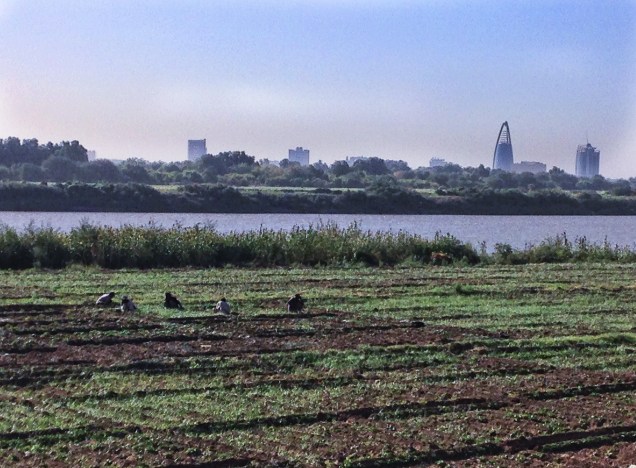
Viewed from the bank of the Nile in Morada (the district of Omdurman where we live), or from the bridge we cross into downtown Khartoum, Tutti Island is a beautiful spot of green agricultural fields right in the convergence of the Blue Nile and the White Nile. It looks peaceful and serene, an irresistible draw if you’re growing weary of the dusty, busy city.
Looking over to Tutti Island from the banks of the Nile in Omdurman, where we live. The foreground is actually Omdurman, but it’s very much how Tutti itself looks when you’re standing on the bridge just south of Tutti Island.
View of downtown Khartoum from Tutti Island, taken from near the mogran.
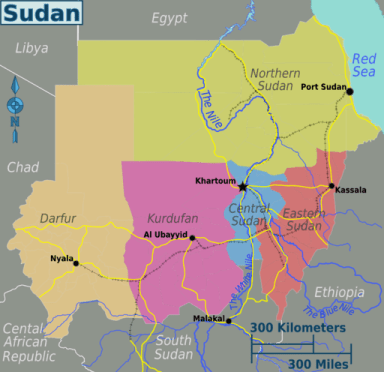
We arrived in Khartoum very early the morning of Tuesday 16 January. I am surprised how busy we’ve been since then. Between getting to know our immediate neighborhood, setting up internet service on our phones and laptops, and figuring out where to buy food, we’ve also been trying out our Arabic (Alan’s is pretty good; I have about 12 words of Arabic right now.)
Tomorrow we fly from London to Khartoum, Sudan. This is the piece of our three-year sojourn we planned the most intensively. We will be part of theSudan Volunteer Programme, a 21-year-old nonprofit that places native (or fully fluent) English speakers around Sudan to teach English conversation to Sudanese university students.
A lot of people have asked us, “Why Sudan?” Now is a good time to answer that question, before we jump in and get so involved that the answer changes, and becomes something else.
After a lovely Christmas in Malmesbury with the family of our daughter’s partner, we have been back in London for two weeks. That’s given us lots of time to walk in many parts of the city, and from one neighborhood to another.
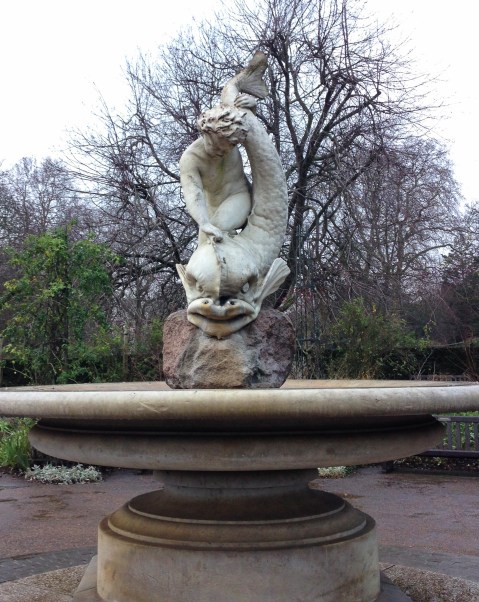
One of my favourite statues in London: the boy and the dolphin in Hyde Park. This piece makes an appearance in Mary Poppins (the first book).
Among its other advantages – fascinating history, varied historical and modern architecture, human-scale streets – London has wonderful parks that beckon to the urban hiker. On this visit, we’ve walked through Hyde Park and adjoining Kensington Gardens; Southwark Park; West Ham Park; and a multitude of smaller parks and squares throughout the city.
All these parks are filled with huge old trees, beds of varied plants (and some that are flowering now: hellebores, daphne, snowdrops and cyclamens, to name just a few), and wildlife. Yes, wildlife! This morning, we saw a fox in Southwark Park. It was climbing across the top of a vine-filled arbor, trying to get away from the humans staring at it. I wish I had thought to get a photo, but I was too excited to think about grabbing my phone.
Yesterday our friends Satheesh and Bade sent us to visit V.K. Munusamy, an artist who makes traditional terracotta statues and sculpture, including traditional Tamil village horses and guardians. These statues are a familiar sight to those who have visited rural Tamil villages, and the making of them is a very old tradition. In Munusamy’s family, it’s a tradition that goes back 22 generations.
Munusamy lives in Villianur, about 7 kilometers from Pondicherry. It’s a pleasant village that is also home to a large and interesting Shiva temple, where we stopped for a quick visit along the way.
Pilgrims from Maharashtra dancing on Gokarna Beach
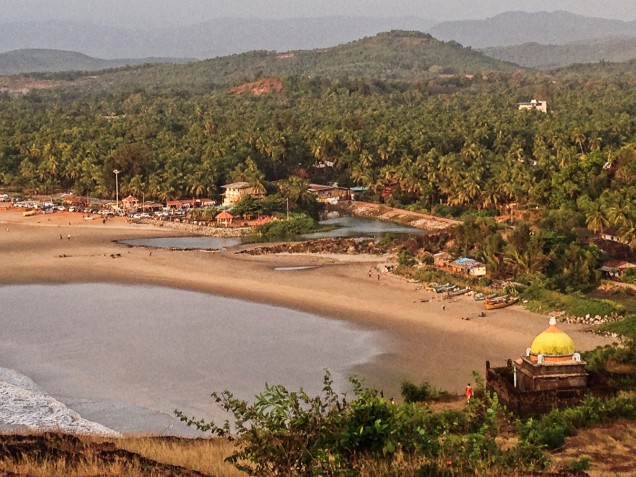
Gokarna is famous for having five beaches that spread southward from the largest of them, Gokarna Beach. Each is very different in character; we have visited four of them, not quite making it to the fifth. (You might want to read this overview post about Gokarna, which also has a bit about the temples.)
Gokarna Beach is easily five kilometers long from headland to headland. We’ve walked most of it, stopping at Namaste Garden a couple of times for breakfast or tea.
The cyclone that hit Kerala days ago, roiling the surf here at Gokarna, has finally arrived. We sit in the Prema restaurant, enjoying a cup of tea while we wait for our lunch to arrive. Wind drives rain against the small shops and tall coconut palms, and in sheets across the street. Deep puddles grow deeper, and even the vagrant cows huddle together under shop awnings, reluctant to emerge in such conditions. We drink tea, we eat slowly, we order more tea, as we wait for a moment when the rain pauses.
We love visiting Indian temples, whether living or historical (and sometimes, as at Pattadakal in Karnataka, it’s a bit of both). So we were looking forward to spending some time at the Sri Sita Ramachandran Swamy temple in Bhadrachalam – but we had no idea just how much time we’d end up spending there.
It took just one day in Bhadrachalam to make us decide we needed to stay longer than the three nights we originally booked. It’s a lovely small town, located upriver from Rajahmundry on the same side of the Godavari, offering plenty of temples, a couple of nice short walks along the river, and the chance to take a one- or two-day river trip among the scenic Papikondulu Hills. So we asked Mr. Ramachandran, the owner of the hotel where we stayed, if we could stay another eight nights.
During our time here in Rajahmundry, we’ve remarked on just how many men we see dressed in black. We know these are people going through the 41-day period of fasting and abstinence that pilgrims undertake before traveling to Sabrimala in Kerala, a temple dedicated to Ayyappa, or Ayyappan, as he’s also called.
I knew about these pilgrimages when I lived in India during the early 1980s, but I really didn’t know anything about Ayyappa. Today we learned a lot about this god when we stopped off in the early morning at the Sri Ayappa Swamy temple beside the Godavari River.

 Yesterday our friends Satheesh and Bade sent us to visit
 We love visiting Indian temples, whether living or historical (and sometimes, as at Pattadakal in Karnataka, it’s a bit of both). So we were looking forward to spending some time at the Sri Sita Ramachandran Swamy temple in Bhadrachalam – but we had no idea just how much time we’d end up spending there.
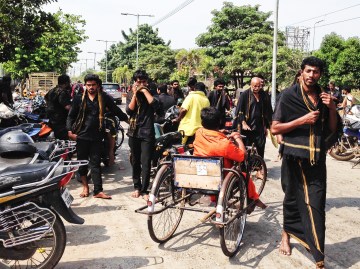 During our time here in Rajahmundry, we’ve remarked on just how many men we see dressed in black. We know these are people going through the 41-day period of fasting and abstinence that pilgrims undertake before traveling to Sabrimala in Kerala, a temple dedicated to
  Rambulatory
