 He was in his accustomed place every morning: sitting on a stool just inside the kitchen door, cutting up onions or boiled potatoes and dropping them into a huge steel bowl.
Though we usually arrived early at Kirpal Singh’s, it was already hot in this pre-monsoon season, the air in the restaurant thick and close with humidity. As soon as we entered, sweat would begin to bead up on my face. The kitchen must have been even hotter.

 They’re building a Jain temple on the higher land above the little town of Amarkantak. Saying “a temple” is really a little misleading – it’s a huge, impressive structure, with an even taller tower close by. And these buildings are just part of a larger planned complex.
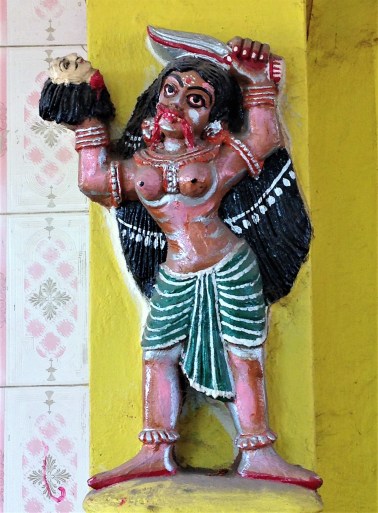 The goddess Kali is everywhere in Puri, portrayed in some of the fiercest, wildest, most bloodthirsty forms I have seen in our travels around India. A string of human skulls around the neck is nothing – Odishan Kalis have blood dripping from their mouths, they plunge lances into the chests of the humans below their feet, their eyes are crazed with lust for yet more blood.
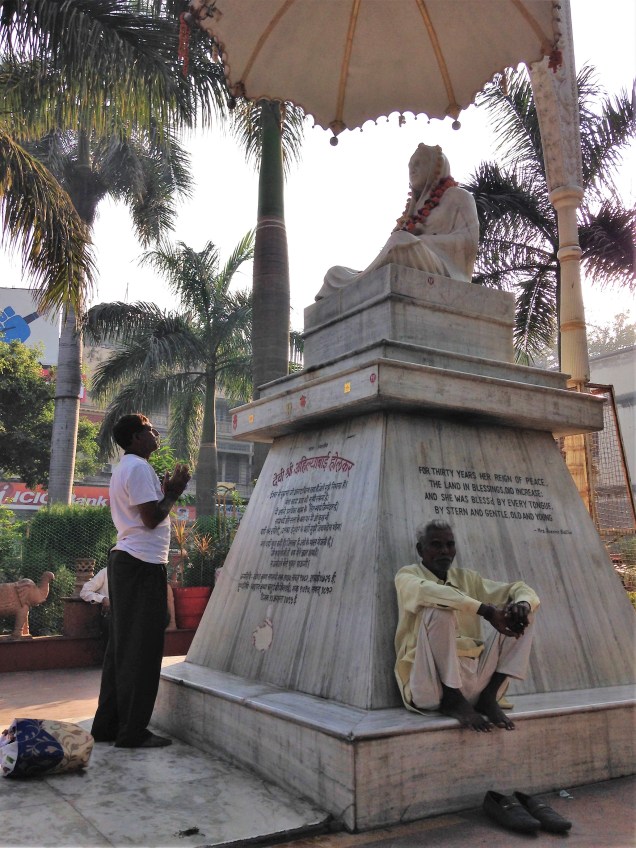 Glancing up from my phone to tell Alan what I’d learned, I saw a man standing before the statue of Ahilyabai, his hands folded in prayer. I watched as he prostrated, then sat in meditation at her feet. That’s when I understood Ahilyabai is much more than a historical figure, or even a heroine: She is a goddess.
 Every long-term India traveler hits the wall eventually: the expiration date on your current visa. Some travelers simply choose to travel in other countries. Neighboring Sri Lanka and Nepal are interesting places in themselves, and of course Southeast Asia is another popular region. But for people who want to stay in India continuously to work on yoga, study meditation, volunteer or simply hang out in a place that’s meaningful to them – the visa run is a natural solution.
 Rambulatory